Heirs of The Promise
by the late Sheldon Emry
- Read more about Heirs of The Promise
- Log in to post comments

by the late Sheldon Emry
CANNIBALISM ACCORDING TO BAKER
Over a very large part of the secluded area there is no evidence that human flesh was ever eaten, and no first-hand account of it is recorded by Fynn, Livingstone, Galton, Speke, or Baker. In several places the native inhabitants knew that cannibalism existed elsewhere; Speke and Baker give examples of this. Fynn mentions a tribe living in the vicinity of the Zulu that was stated to have taken to eating human flesh when their cattle were stolen; but this was not confirmed by direct observation, and the vast majority of Kafrid tribes were never cannibals, so far as is known. No suggestion is made anywhere that any Nilotid was ever a cannibal. Schweinfurth remarks of the Dinka (Ni), ‘It is scarcely necessary to say that the accounts of the cannibalism of the Niam-Niam excite as much horror amongst them as amongst ourselves.’
 Hérodote, Scythes, Perses & Prophétie
par William Finck
 by William Finck
El propósito de esta exposición es mostrar cómo, si uno no está familiarizado con la historia secular (de los cuales gran parte se encuentra en los clásicos griegos), uno no va a entender completamente las Escrituras. La nación de Judea compuesta principalmente de "higos malos" (hoy llamado "Judíos") no se dispersan hasta el año 70 DC, como fue profetizado en Jer. 24:8-10, 26:6, 29: 17-19., Cristo mismo lo afirmó en Lucas 21:24. Mientras que Santiago en 1:1 habla de las "doce tribus que están dispersas en el extranjero", y Santiago murió antes del 70 dC, como atestigua Josefo, Santiago no se dirigía a la denominados "Judíos" dispersos en el año 70, y tampoco pudieron los " Judíos " haberse ya extendido en el extranjero, afirmar ser descendientes de las tribus que no sean sólo tres, Judá, Benjamín y Leví, y sólo una pequeña fracción han reasentado Judea a su regreso de Babilonia.
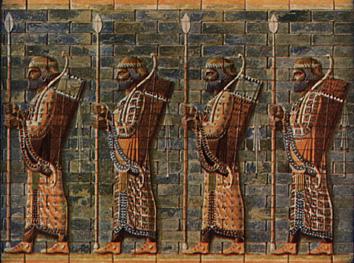
A excepción de su larga descripción de Egipto en el libro 2, y sus otras incursiones en el pasado, Herodoto dio la historia de Persia, que abarca el reinado de cinco reyes: Ciro (1. 46) Cambises(. 2 1) pseudo-Esmerdis ( 3. 67), Darío (3. 88), y Jerjes (7. 5). Estos reyes son los mismos reyes que nuestro profeta Daniel habla en Daniel 11:1-2.
Tilgangur þessarar afflettu er að sýna fram á að sé maður ekki kunnugur veraldlegri sögu ( sem mikið af er að finna í Grískum klassískum bókmenntum), muni sá ekki að fullu skilja Ritninguna. Þjóð Júdeu sem samanstóð mest af " slæmum fíkjum" ( sem kallast í dag "Gyðingar") var ekki dreift fyrr en 70 e.Kr, eins og var spáð fyrir í Jer. 24:8-10, 26:6, 29:17-19 et al., staðfest af Kristi sjálfum í Lúkasarguðspjalli 21:24. En Jakobsbréf 1:1 talar um " tólf kynkvíslir í dreifingu", og Jakob dó fyrir 70 e.Kr, eins og Jósefus staðfestir, Jakob var ekki að tala við hina svokölluðu "Gyðinga" dreift árið 70, og hvorki gátu þeir "Gyðingar" þegar útbreiddir um heiminn sagt sig vera komna af ættkvíslunum öðrum en þremur, Júda. Benjamín og Leví, og aðeins örlítið brot af þeim nam land á ný í Júdeu eftir heimkomuna frá Babylon. Umfram fyrir langa lýsingu sína á Egyptalandi í bók 2, og öðrum athugunum sínum á fortíðinni, gaf Heródótos lýsingu á sögu Persíu samkvæmt ráðatímum fimm konunga: Kýros(1. 46), Kambýses(2. 1), Súdó-Smerdis(3. 67), Daríus (3. 88), og Xerxes (7. 5). Þessir konungar eru nákvæmlega sömu konungar og þeir sem Daníel spámaður okkar talaði um í Daníelsbók 11:1-2.
By 'fundmentals' we speak of things like: summer, winter, autumn, spring, you know, things that politicians cannot change or which they change only to the detriment of the order of things. There is an ultimate order, and the closer we attain to it, the greater becomes our personal and national wellbeing.
The trick is to discover the fundamental non-negotiables that harmonise with natural law. Once that is established half the battle is won. We who are Bible-believing Christians have the advantage of possessing the Book of Rules that provide for us the remaining answers to our quest for a successful national constitution ensuring prosperity, but not necessarily peace. We
know that because we have lived through pockets of time where this was demonstrated. Pre-war Germany and post-war South Africa knew both sides of that equation. The prosperity generated in wicked men and wicked systems jealousy and hatred that proved terminal for both successful systems.
PART 1 - THROUGH THE 19TH CENTURY - History Of The Money Changers - Hitchcock
HISTORY OF THE MONEY CHANGERS
By Andrew Hitchcock
February 26, 2006
Economists continually try and sell the public the idea that recessions or depressions are a natural part of what they call the “business cycle”.
This timeline below will prove that is simply not the case. Recessions and depressions only occur because the Central Bankers manipulate the money supply, to ensure more and more is in their hands and less and less is in the hands of the people.
Central Bankers developed out of money changers and it is with these people we pick the story up in 48 B.C. below.
Hitler et le Christianisme Homme et Bête
The pair are due to marry on Oct 9 at the register office in Devizes before holding a service at St John the Baptist Church Photo: SWNS

We can hardly approve of much of their work, but here The Kinks aptly describe the state of Britain today.
This website is a project of Christogenea.org

For Christogenea books and other merchandise, visit our page at Christogenea.com.